
Liquidity Tailwinds, Emerging Constraints
April 20th 2026
Bottom Line
Liquidity has been the dominant driver of markets in recent weeks.
At the same time, key funding conditions are beginning to shift — introducing constraints that have not yet shown clear effects in market behavior.
The Setup
Over the past three weeks, markets have moved higher in a fairly consistent way.
Equities are at all-time highs
Bitcoin has recovered toward recent highs
Market breadth has improved meaningfully
Volatility has compressed
Taken together, this has been a strong environment for risk assets.
The question is not what has happened.
The question is:
What is driving it — and is that still intact?
Liquidity Has Been the Driver
The recent move in markets has been supported by a clear liquidity tailwind.
One of the most important developments over the past few weeks has been the behavior of the Treasury General Account (TGA).
The TGA has declined meaningfully from recent highs
This effectively releases liquidity back into the system
In practical terms, it increases available reserves and supports risk-taking
This is a mechanical relationship that is worth paying attention to.
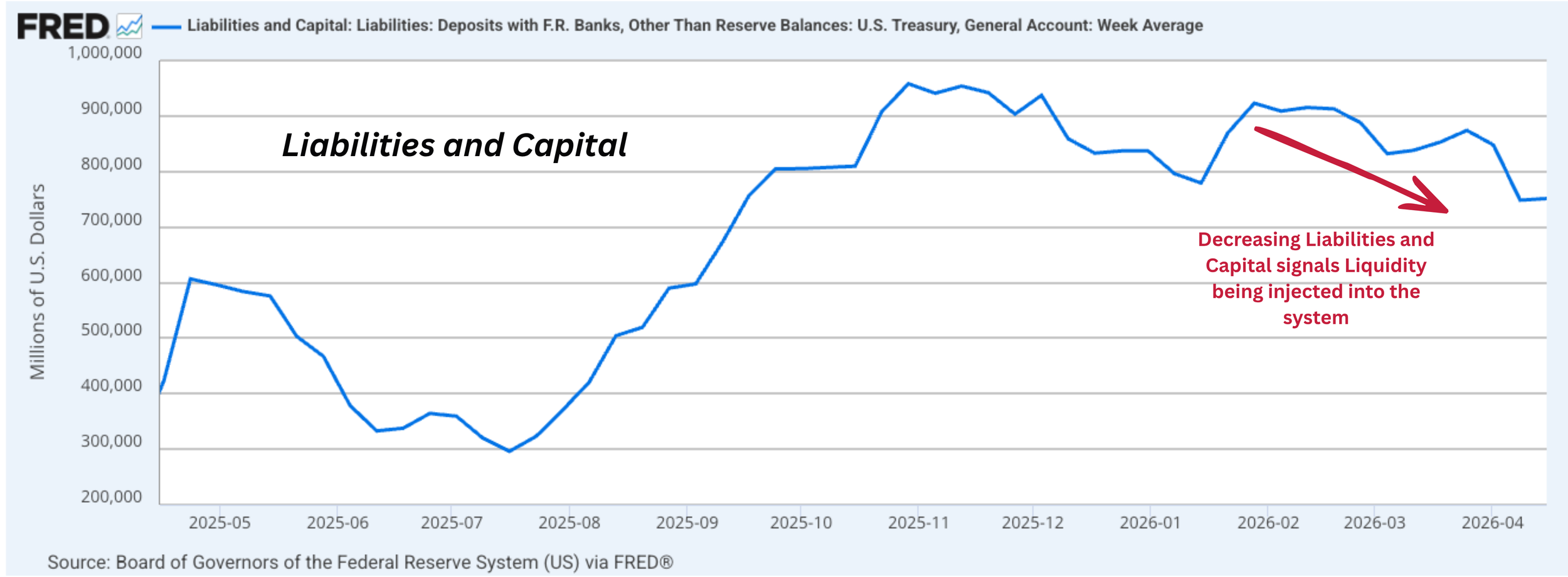
And the timing aligns closely with what we’ve seen across markets:
SPX pushing to new highs
Bitcoin recovering alongside broader risk
Breadth improving (62% of stocks above 200DMA vs ~45% several weeks ago)
VIX declining sharply from recent elevated levels
This does not require a strong improvement in fundamentals.
When liquidity expands, markets tend to respond.
At a high level, the past few weeks can be understood as a liquidity-supported advance.
A New Constraint Is Emerging
While domestic liquidity has improved, cross-border funding conditions are becoming less accommodative.
The spread has tightened to its lowest level in roughly 12 weeks
This is a meaningful shift in a key global funding channel
Why this matters:
Global capital often flows toward higher-yielding USD assets
A wider spread supports this dynamic
A tighter spread reduces that incentive at the margin
This affects:
Carry trade economics
Cross-border capital flows
The broader transmission of global liquidity
Importantly:
This is not yet an outcome — it is a change in conditions.
The System Is No Longer One-Directional
Over the past few weeks, the setup was relatively straightforward:
Liquidity improving → markets moving higher
Now, the picture is becoming more balanced.
Two forces are beginning to coexist:
| Force | Direction | Status |
|---|---|---|
| Liquidity (TGA) | Supportive | Active |
| Funding (UST–JPY) | Tightening | Emerging |
At this stage:
Liquidity remains supportive
Funding conditions are becoming less so
There is no clear evidence yet that this shift is impacting markets directly.
But the system is no longer uniformly moving in one direction.
Are There Early Signs of Change?
Conditions remain stable, but the structure beneath the rally is worth monitoring.
1. Markets at highs in a complex backdrop
SPX is trading at all-time highs
This is occurring alongside ongoing geopolitical tension
The market is showing resilience, but also leaves less margin for error
2. Volatility has compressed
VIX has moved down significantly from recent peaks
This reflects stability — but also reduces the buffer against shocks
3. Breadth has improved
Participation has broadened (now ~62% above 200DMA)
This is constructive, though not yet indicative of extreme expansion
It’s a market to:
• Observe behavior
• Compare relative positioning
• Act selectively
4. Credit remains stable
High yield spreads are contained
No signs of stress — but also no strong signal of accelerating growth
Taken together:
There is no clear deterioration — but also no strong evidence of underlying acceleration.
What Would Confirm This Matters
The key question is whether the emerging constraint begins to translate into market behavior.
We can define this in observable terms.
Signals that would suggest the constraint is becoming impactful:
Continued tightening in the UST–JPY spread
Slowing or reversal in TGA drawdown
Weakening in equity breadth
A sustained move higher in volatility
Widening in credit spreads
Signals that would suggest conditions remain supportive:
Continued liquidity injection via TGA
Stabilization or widening of the UST–JPY spread
Ongoing improvement in breadth
Stable volatility and credit conditions
What We’re Watching Next
Direction of the TGA balance
Behavior of the UST–JPY spread
Market breadth (% of stocks above 200DMA)
Volatility regime (VIX levels and trend)
Credit spreads (high yield OAS)
Closing Thought
Markets have moved higher in recent weeks, supported by improving liquidity conditions.
That remains true.
But at the same time, parts of the system are beginning to shift in a different direction.
The key question going forward is not whether liquidity has been supportive —
but whether it can continue to offset the constraints that are now beginning to emerge.
Look out for next week’s newsletter for further insight into the forces shaping today’s markets.